if I ask you what are the best inventions made by humans so far? You may say: phones, cameras, computers, cars, televisions and air-planes, but many forget one tiny device which without it we wouldn’t have most of those inventions! That device is called the transistor. Many have said it’s the most important invention of the 20th century, Since it transformed the world of electronics and it was the entry to the digital world.
What is a transistor?
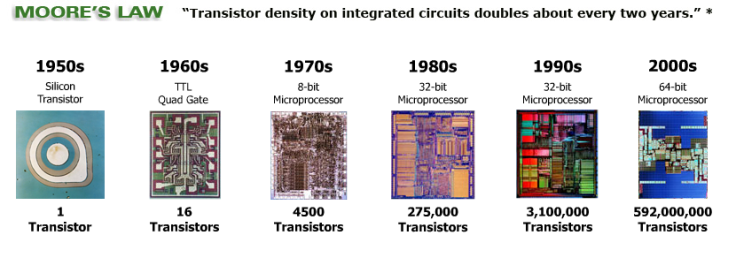
transistors used for CPUs throughout the years 
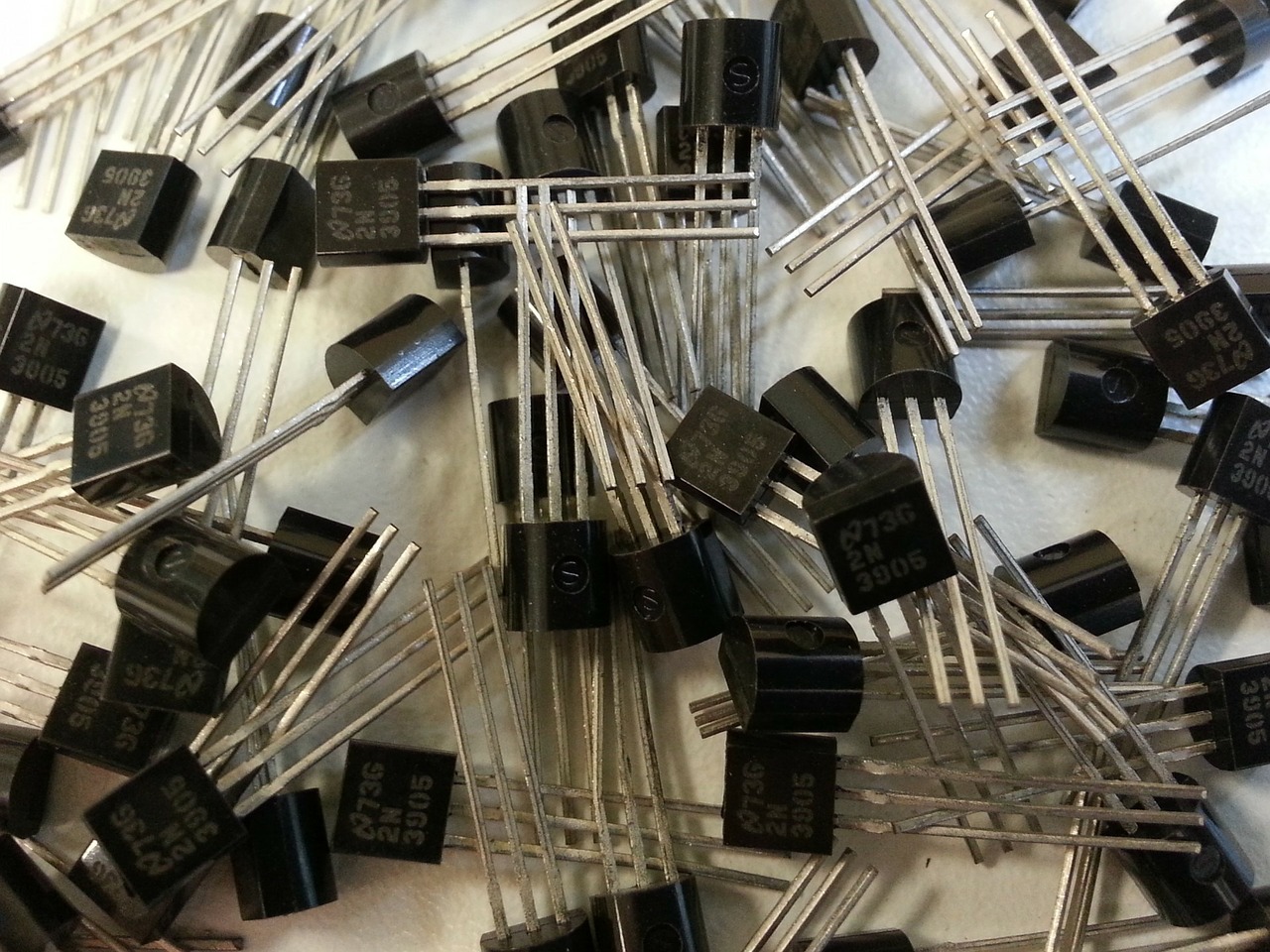
Hobiest transistor
A transistor is a device composed of semiconductor material. It can used as a switch or for amplifying signals. It usually has three terminals (or legs), small current or voltage has to be applied to one of three three legs in order to control the current passing through the other two pair of terminals .
Before getting into more details about this incredible device, we should look first at some history and science behind it
Some History and science
Before the invention of transistors, “triode vacuum tubes” were used for the same functionality . These devices were invented in 1907,they were bulky evacuated glass bulbs that consisted of three parts; cathode, grid and anode.
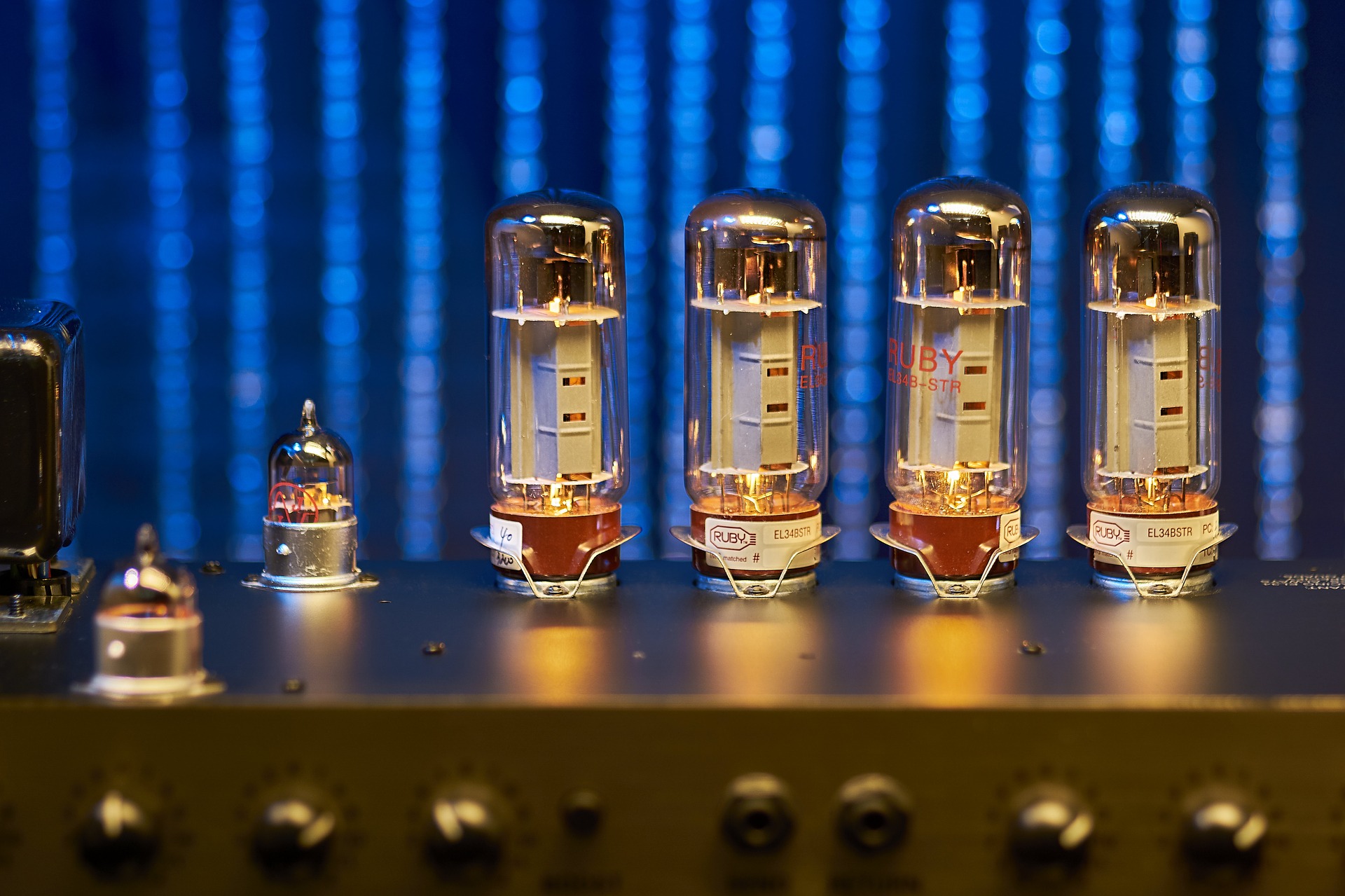
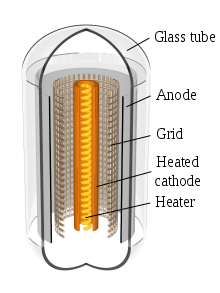
A high amount of current had to be applied to the cathode in order to heat up and release electrons, which get attracted by the anode and complete the circuit. The grid was used to manipulate this circuit, if positive voltage was applied to it the circuit will be closed and devices connected to it would work. However, if the voltage applied was negative , the circuit then will be opened and nothing would work. This functionality is the foundation of binary coding (which we know as zeros and ones in the digital world).
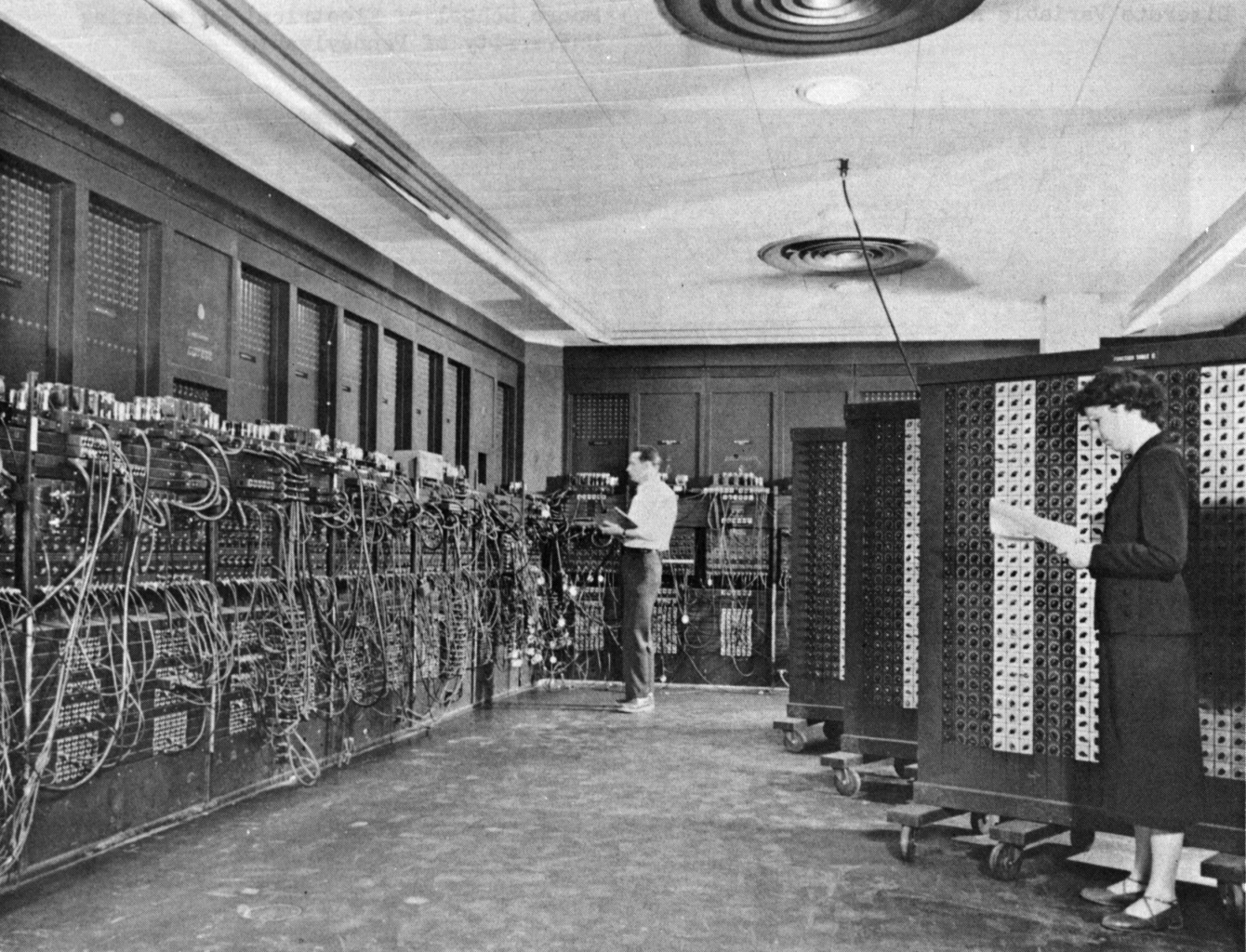
The first computer (the ENIAC) was based on these vacuum tubes, but since these devices took a lot of space , that computer had the size of a whole room and was very power consuming. Also they were very fragile, so an alternative had to be discovered.
From November 17, 1947, to December 23, 1947, John Bardeen and Walter Brattain at AT&T’s Bell Labs in Murray Hill, New Jersey of the United States performed experiments and observed that when two gold point contacts were applied to a crystal of germanium, a signal was produced with the output power greater than the input. these experiments resulted int the the technology behind transistors. few years later Early commercial models of transistors were produced, but they had quite a large size which was similar to that of the vacuum tubes. However, they were much durable and power efficient. And throughout the years and thanks to nano-technology the size of transistors kept shrinking tremendously until it reached to only few nano-meters. so the ENIAC computer nowadays can be shrinked to small chip of few millimetres.

John Bardeen, William Shockley and Walter Brattain at Bell Labs, 1948(Photo Credit: AT&T/Jack St via Wikipedia) 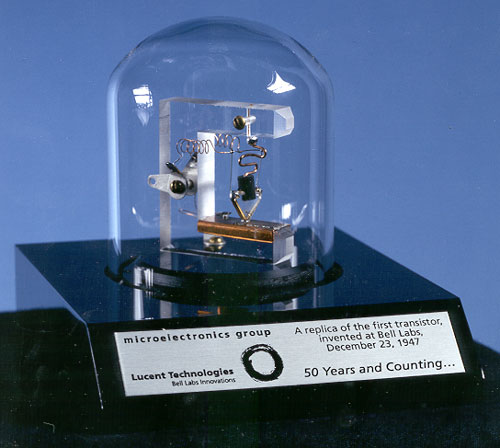
A replica of the first working transistor.(wikipedia)
How does it function?
Transistors are made mainly from silicon, which is known as a semi-conductor. this means that it is neither a good conductor nor an insulator. If we treat silicon with impurities (also known as doping) we can control its conductivity. if we dope it with certain chemical elements like phosphorous it will gain some “free” (additional) electrons which makes it easier for current to flow, thus it becomes more conductive . However if we dope it with other elements like aluminium it will gain a positive charge and it will be hard for current to flow , which results in a more insulating material.
This doping method is used for making different types of transistors, and since most of them function similarly we will only explain the NPN type transistor which is commonly used .
NPN stands for (Negative-Positive-Negative) regions, this means that two regions have negative charge which are called the collector and emitter)and one region has positive charge and is called the base . ( look at the following figures)
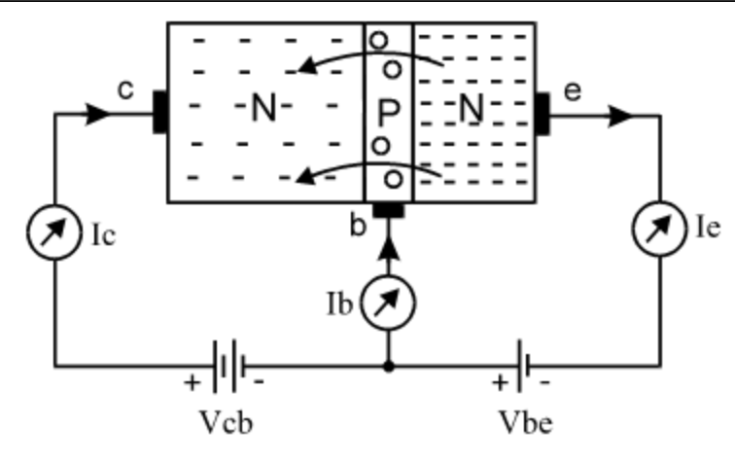
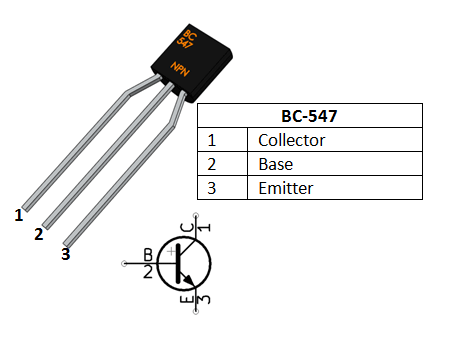
When no current is applied to the base region it serves as an insulator and it doesn’t allow current to flow from the collector to the emitter. However if we apply small current to the base it gains some electrons and it allows current to flow. so and device connected to the two terminals (collector and emitter) will turn on.
Transistors work using the same principles of their predecessor technology (triode vacuum tubes), they can function as a switch or as an amplifier.
1- As a switch
Mostly Transistors are used in digital circuits as small electronic switches which can be either in an “on” or “off” state or “1”or”0″ in binary.
When a small amount of current (or voltage for some types of transistors) is applied to the base of the transistor , current will flow through the other two terminal. this allows to switch any device connected to these terminals ON and OFF .
Switching between a HIGH state and a LOW state is recognized by computers as 0 and 1. And since the CPU of a computer contains millions of transistors, it can perform millions of binary operations in a second.
2- As an amplifier

In some types of transistors, the current through the collector is Linearly Proportional to the one entering the base . it follows that any current signal entering the base will be amplified and leave through the collector.
Importance
This tiny device is the building block for the processor, it is the key active component in practically all modern electronics. Without the transistor, laptops and smartphones would still exist only in the fiction world. Our televisions would still use vacuum tubes and most of today’s highly automated manufacturing systems wouldn’t be possible.
The transistor’s low cost, flexibility, and reliability have made it a ubiquitous device. Transistorized mechatronic circuits have replaced electromechanical devices in controlling appliances and machinery. It is often easier and cheaper to use a standard microcontroller and write a computer program to carry out a control function than to design an equivalent mechanical system to control that same function.
So, the next time you get asked about what are the best inventions of this era, make sure to keep the transistor on top of the list.
 INELECTRONICS TECH Blog
Leave a comment